

Interview
Saharra Dixon: Theatrical Neurology, Narration and Self-Clamation
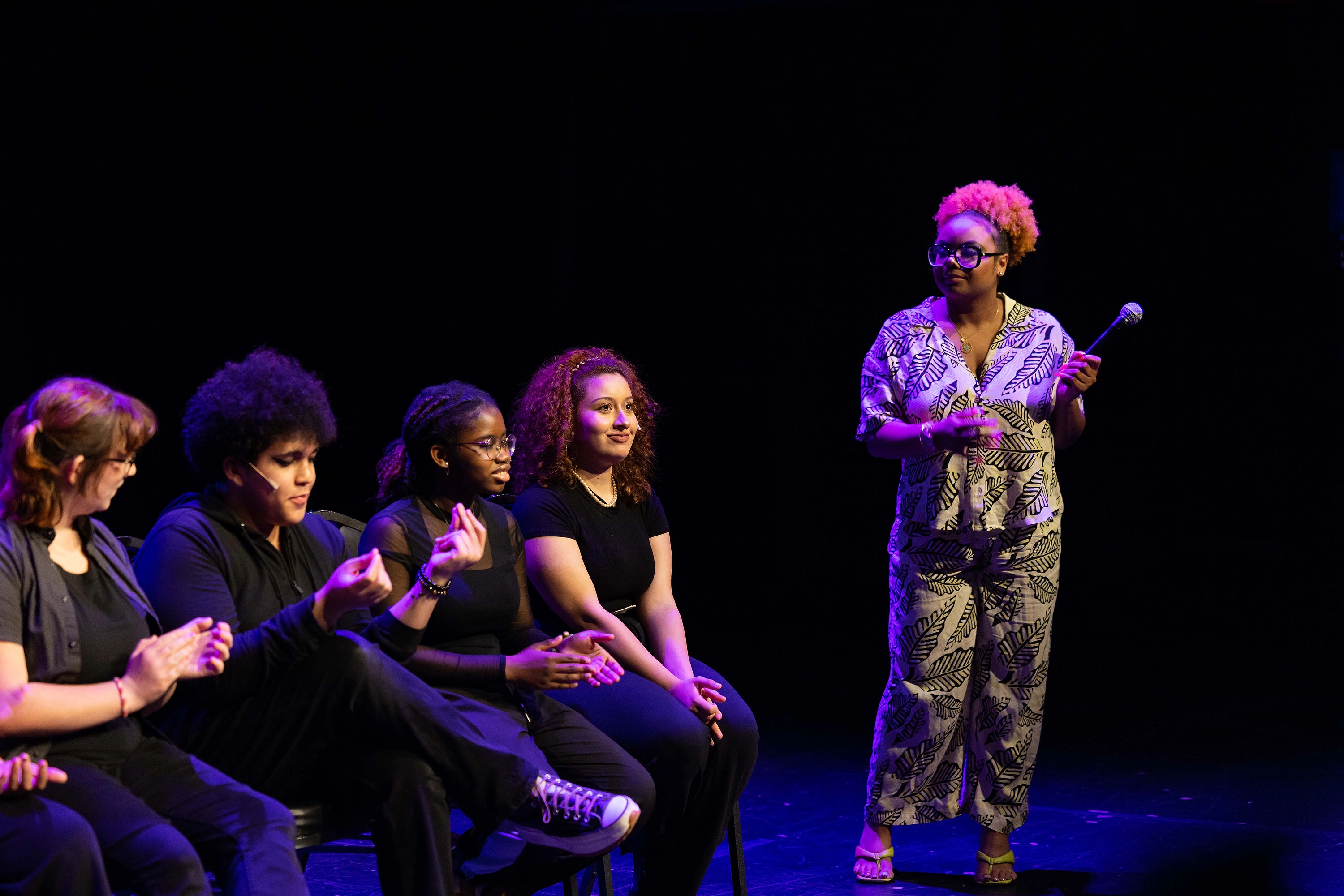
Engaging the intrapersonal and interpersonal realms through self-clamation and alternative onto-epistemologies enabled by the theater.
ARTOEND Editorial Team
24 July 2026
«[Theatre] asks us to return to the body. Storytelling also helps us make meaning of what's happening to us; it allows us to embody that meaning, move around it, play with it, sometimes transform it.»

Dr. Saharra Dixon is a health behavior scientist and public health storyteller transforming brain and behavioral health equity through embodied storytelling and narrative resistance. As an arts in health scholar-artist, she helps communities imagine and build healthful futures by empowering everyone to experience the healing power of the arts. Her work has been recognized with a 2026 Renée Fleming NeuroArts Investigator Award and 2022 Active Minds Emerging Scholars Fellowship. In 2025, she received the Health Promotion Practice Sarah Mazelis Paper of the Year Award. Dixon received her PhD in Public Health from UMass Amherst and is the owner of the Creative Methods Studio.
Getting to know Dixon, our conversation started off with a look into her journey thus far. Operating in the intersection of public health, theater arts, and neuroscience, when we asked about the motivation and path which precedes her commitment to the field, Dixon offers us with textured anecdotal accounts. Having to navigate body-focused repetitive behaviors (BFRBs), specifically trichotillomania, since the age of 10, she recalls the affective sphere of isolation and shame which had been present before her development of the corresponding linguistic reservoir to describe and process them. In light of said experience, her searching on the world wide web at the time, aimed at better understanding of self, became her first engagement with researching. Eventually, her arrival and stay in her field, reminiscent of said personal account, is rooted in the realization that her presence can help bring inclusivity to the academic discourse — concerning herself with the experience of Black women and femmes, an aspect often left unexplored in the current clinical literature.
“I stay because I know this work is bigger than me. I stay because there is medicine in our stories. And, I stay because research can be a tool for restoration and healing when it’s done with care and intention.”
Theatrical aesthetics as neuroaesthetics
In the contemporary landscape of neuroscience, Dixon’s pairing of cognitive neuroscience and theatrical arts emerges as a unique nexus at which the aesthetic is involved with the wholeness and totality of practice, moving further than engaging only the audiovisual. Dixon shared with us about her journey towards this intersection. She has engaged in theatre arts from the age of 5 at New Freedom Theatre in Philadelphia, PA, a historically African-American theater, founded on the basis of the Black Arts Movement.
Trained for subsequent years, doing auditions and off-Broadway plays in the city of New York, by the time she was an undergraduate student at the University of Delaware, Dixon found herself pursuing public health. As she familiarized herself with the field and discovered that behaviors were discussed without attention to the body, the embodied, and contexts, theatre resurfaced to her as a means to mitigate this gap.
Theater, as a neurological intervention, according to Dixon, is a more holistic approach for its convergence of the embodied, relational, and rehearsible. Utilizing the cooperation of gestures, movements, breath work, voice, posture, and spatial awareness, the way in which the theatrical engages the nervous system in a way that would not be delivered by any other art forms. Introducing Theater of the Oppressed, a methodology in drama by Augusto Boal, she explains that the aesthetic distance present in theatrical reenactments allow individuals to externalize their experiences, to place them into scenes, to rehearse alternative endings or liberation without the risk of re-traumatization. In a sense, the phenomenological structure of inhabiting a character allows the participant to process their experience from a different onto-epistemology.
Continue reading
Unlock this issue to read the full piece.
One purchase unlocks every online section in this issue.
Unlock the issueBack to the issue