

Artworks
Techno-Corporeality and Embodied Mind
Oscillating between neurology and aesthetics, this dance-based work constructs a wholeness where the distinction between the external and internal becomes indistinguishable.
ARTOEND Editorial Team
24 July 2026
«This recursive exchange creates a heightened state of awareness in which perception, cognition, and physicality continuously influence one another.»
Yeewon Chong is a multidisciplinary artist and functional neuro-clinician whose work encompasses neuroscience, somatics, movement, and digital visual art. Her interdisciplinary projects have been presented internationally, including at SXSW and TEDx, and featured by Neurohumanities website alongside major media outlets including The Star. She was also a finalist in a national art and science prize, recognizing her contributions to emerging dialogues between neuroscience, embodied technologies, and contemporary art practice.
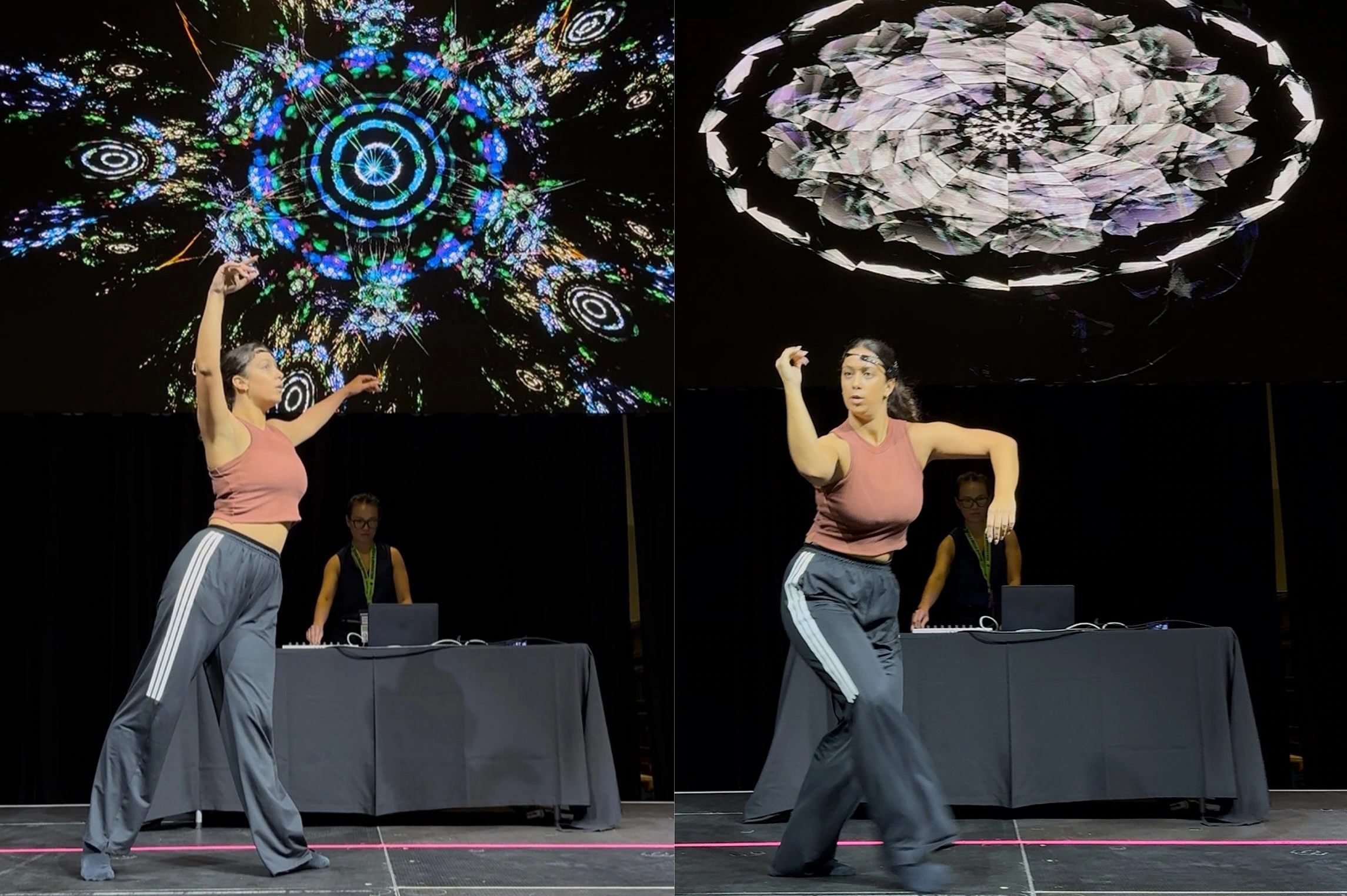
In collaboration with improvise-dancers, like Natalie Cunzolo (figure above), Lee Si Jin (next page, left-hand side), and Jazzie Lee (right-hand side), her Brainwave Mediated Digital Art Through Dance, a mixed media performance, explores choreographical improvisation as a method of inquiry. During the dance, electroencephalography (EEG) is employed to externalize brainwave activity into evolving visual forms. Within the immersive environment, the dance becomes both the observer and the participant, with the corporeal and the surrounding environment functioning as co-constitutions of a whole. The body and the environment in which the former is spatiotemporally situated fused into a coherent aesthetic entity, oscillating as an engine. Improvising choreography while observing electroencephalography, the dancer herself becomes the phenomenon, while her phenomenology of which the phenomenon is a part remains sustained, altering said phenomenon itself.
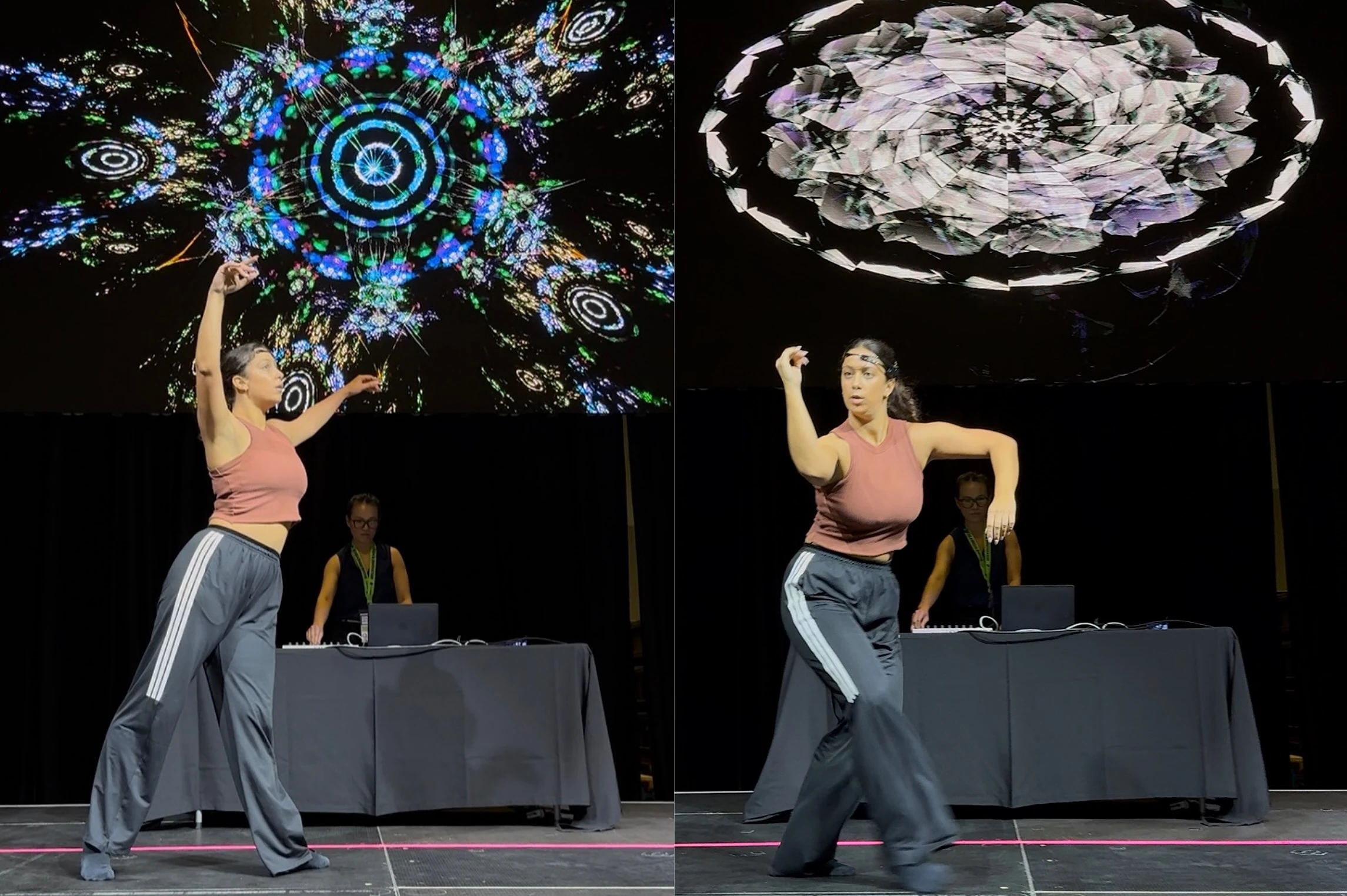
Yeewon Chong: “The project emerged from an interest in understanding how the body thinks, senses, and remembers beyond verbal language or fixed choreography. Rather than approaching dance as a rehearsed spectacle, I treat improvisation as a method of inquiry — one that reveals raw, immediate, and often subconscious forms of expression. The dancer is not performing toward a predetermined outcome but navigating a continuous feedback loop where brain activity generates responsive visuals that are then perceived and embodied again through movement. This recursive exchange creates a heightened state of awareness in which perception, cognition, and physicality continuously influence one another.”
That being said, the feature of the performance in Volume 1 is indebted to how their work actualizes and allegorizes the inseparable, bilateral relations between the aestheticizing mind and the aesthetically possible world in the proper construction of a neuroaesthetic of, and in, life. In which, the onto-epistemology of each constituent becomes indistinguishable, forming an aesthetic engine whose totality gives rise to emergent properties which would have been nonexistent otherwise. Likewise a comprehensive imagination of neuroaesthetics when brought into life, the directionally opposing yet interrelated domains in Brainwave Mediated Digital Art Through Dance are not capable of being considered on an individualized basis. Indeed, Chong herself seeks to deconstruct another diamorphic distinction through this work. She aims to break the binary opposition between the corporeal and the technological, using technology to engage and assist embodied knowledge production, which by itself is not without exigency in the increasingly diverse and transdisciplinary landscape of, and between, empiricality and subjectivity, digital and analog, neurological and aesthetic inquiries.
Continue reading
Unlock this issue to read the full piece.
One purchase unlocks every online section in this issue.
Unlock the issueBack to the issue